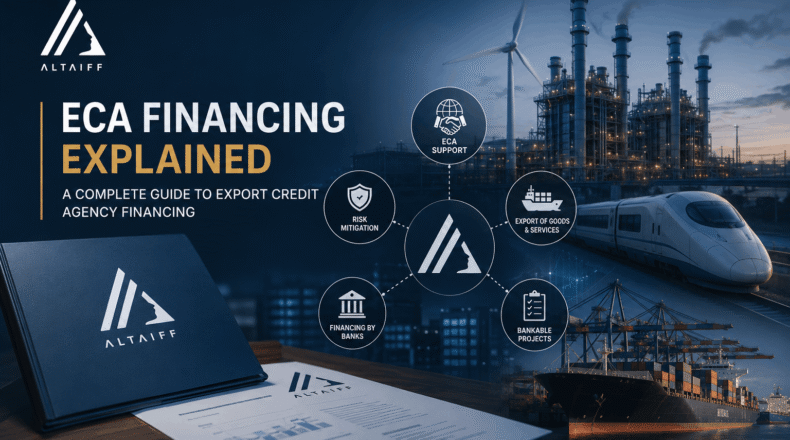
Introduction
Large infrastructure, energy, industrial, and transportation projects often require financing that extends beyond the capacity of commercial banks. While traditional lenders may hesitate to provide long-term funding for capital-intensive projects, Export Credit Agencies (ECA) help bridge this gap by supporting the export of goods and services through government-backed financing solutions.
Today, ECA financing has become one of the most important funding sources for major international projects. It enables governments, project sponsors, and private companies to secure long-term financing on competitive terms while reducing political and commercial risks.
Whether the project involves a power plant, railway, manufacturing facility, water treatment plant, airport, or renewable energy development, understanding how ECA financing works is essential for developers seeking institutional funding.
What Is an Export Credit Agency (ECA)?
An Export Credit Agency (ECA) is a government-backed institution established to promote a country’s exports by providing financial support, guarantees, insurance, and credit facilities to domestic exporters and international buyers. ECAs play a vital role in facilitating cross-border trade by reducing the financial and political risks associated with international transactions, particularly for large-scale infrastructure, industrial, energy, and transportation projects.
Unlike commercial banks, whose primary objective is to maximize financial returns, Export Credit Agencies are designed to support national economic growth by enhancing the global competitiveness of domestic companies. They enable exporters to offer attractive financing terms to overseas buyers, making their products and services more competitive in international markets.
In project finance, ECAs often work alongside commercial banks and institutional lenders to provide long-term financing solutions for projects involving the export of equipment, technology, engineering services, or construction expertise. Their participation can significantly improve a project’s bankability by mitigating risks that private lenders may be unwilling to assume on their own.
Export Credit Agencies typically support projects through a combination of direct loans, loan guarantees, export credit insurance, and buyer or supplier credit facilities. These mechanisms reduce lenders’ exposure to commercial and political risks while allowing borrowers to access larger financing amounts, longer repayment tenors, and more competitive financing costs.
Today, ECA-backed financing has become one of the most important sources of funding for major infrastructure and industrial developments worldwide, particularly in sectors such as renewable energy, power generation, transportation, water treatment, manufacturing, mining, and public-private partnership (PPP) projects.
Examples of Major Export Credit Agencies
Several countries operate well-established Export Credit Agencies that support international trade and project financing, including:
- UK Export Finance (UKEF) – United Kingdom’s official export credit agency, supporting British exporters through guarantees, insurance, and direct lending.
- Euler Hermes (Germany) – Administers Germany’s federal export credit guarantee program, helping German exporters expand into international markets.
- SACE (Italy) – Italy’s export credit agency, providing financing, guarantees, insurance, and risk management solutions for international projects.
- Export-Import Bank of the United States (EXIM Bank USA) – Supports U.S. exports through loans, guarantees, and export credit insurance.
- SERV (Swiss Export Risk Insurance) – Switzerland’s official export credit agency, offering insurance and guarantees to support Swiss exporters.
- Nippon Export and Investment Insurance (NEXI) – Japan’s export credit agency, providing insurance and financial support for Japanese companies engaged in international trade and overseas investment.
Although each ECA operates under its own national policies and eligibility criteria, they all share the common objective of promoting exports, supporting domestic industries, facilitating international trade, and enabling strategically important projects to obtain long-term financing under competitive conditions.
What Is ECA Financing?
Export Credit Agency (ECA) Financing is a government-supported financing solution designed to facilitate the export of goods, equipment, technology, and professional services from one country to another. It enables project sponsors, governments, and private companies to secure long-term funding for capital-intensive projects while reducing financing risks for both lenders and exporters.
Unlike conventional commercial loans, ECA financing is backed by government-sponsored export credit agencies that provide guarantees, insurance, or direct financial support to encourage international trade and strengthen the competitiveness of domestic exporters.
ECA financing is commonly used in large-scale infrastructure, energy, industrial, mining, transportation, and water projects where substantial capital investment and extended repayment periods are required. It is particularly valuable when projects involve the procurement of equipment or engineering services from exporters located in the ECA’s home country.
One of the primary applications of ECA financing is supporting Engineering, Procurement, and Construction (EPC) contracts. Since EPC contractors are often responsible for supplying major equipment, technology, and engineering expertise, export credit agencies can facilitate financing that enables project sponsors to purchase these goods and services under competitive financing terms.
Depending on the project structure and the participating export credit agency, ECA financing may be provided through several mechanisms:
Buyer Credit
Under a Buyer Credit structure, a commercial bank extends a loan directly to the foreign buyer or project company, while the Export Credit Agency guarantees or insures the loan. This allows the borrower to obtain long-term financing with competitive interest rates and reduced lender risk.
Supplier Credit
In a Supplier Credit arrangement, the exporter provides deferred payment terms to the buyer and subsequently receives payment through financing supported or insured by the Export Credit Agency. This structure enables exporters to offer attractive payment terms without assuming excessive credit risk.
Direct Loans
Some Export Credit Agencies provide financing directly to foreign buyers without the involvement of commercial banks. These direct lending programs are generally available for strategically important exports and are subject to the agency’s financing policies and eligibility requirements.
Loan Guarantees
Many ECAs issue guarantees that protect commercial lenders against borrower default. These guarantees significantly reduce credit risk, encouraging banks to finance projects that might otherwise fall outside their normal lending appetite.
Export Credit Insurance
Export credit insurance protects exporters and lenders against commercial and political risks, including buyer insolvency, payment default, currency restrictions, expropriation, political instability, or other events that could prevent repayment. By mitigating these risks, ECAs facilitate international trade and improve access to financing for cross-border projects.
Through these financing solutions, Export Credit Agencies play a vital role in supporting international trade, strengthening global supply chains, and enabling the successful delivery of large infrastructure and industrial projects that require long-term institutional financing.
How ECA Financing Works
ECA financing involves multiple stakeholders working together to facilitate the successful financing and delivery of international projects. Rather than lending directly in every case, Export Credit Agencies often support commercial lenders by providing guarantees, insurance, or other credit enhancement mechanisms that reduce financing risk.
A typical ECA financing structure follows this process:
1. Exporter
The process begins with an exporter, EPC contractor, or equipment manufacturer located in the ECA’s home country. The exporter supplies eligible goods, technology, engineering services, or construction expertise required for the project.
2. Export Credit Agency (ECA)
The Export Credit Agency evaluates whether the transaction meets its eligibility criteria, including export content, environmental compliance, country risk, and project viability. If approved, the ECA provides financial support through guarantees, insurance, or direct lending.
3. Commercial Bank
A commercial bank arranges the financing facility for the borrower. Since the ECA mitigates a significant portion of the credit risk, banks are often willing to provide larger financing amounts, longer repayment periods, and more competitive pricing than would otherwise be available.
4. Borrower
The borrower may be a government entity, state-owned enterprise, private developer, or project sponsor seeking financing for the purchase of exported goods and services.
5. Project Company (SPV)
In many project finance transactions, the financing is ultimately provided to a Special Purpose Vehicle (SPV), which owns, develops, constructs, and operates the project. The SPV uses the financing to pay the exporter, while future project revenues are used to repay the financing according to the agreed repayment schedule.
This financing structure enables exporters to secure international contracts, lenders to reduce risk exposure, and project sponsors to access long-term financing for large-scale investments.
Eligibility Requirements for ECA Financing
Although Export Credit Agency (ECA) financing offers significant advantages for large-scale projects, it is not automatically available to every transaction. Each Export Credit Agency operates under its own policies and national regulations, but most agencies evaluate projects against a common set of eligibility criteria before providing financing, guarantees, or insurance.
The objective of these requirements is to ensure that public financing supports viable projects, promotes national exports, and complies with international environmental, social, and financial standards.
Export Content
One of the most important eligibility requirements is the level of export content originating from the ECA’s home country. Since ECAs are established to promote national exports, projects must generally include equipment, technology, engineering services, or professional expertise supplied by companies based in the sponsoring country.
Each Export Credit Agency establishes minimum export content requirements, which typically range between 20% and 50% of the total contract value, depending on the country’s policies and the nature of the transaction.
Eligible Country
The location of the project also plays an important role. Most ECAs maintain country risk classifications and determine which countries are eligible for financing based on political stability, economic conditions, sovereign risk, and international sanctions.
Projects located in countries with acceptable political and economic risk profiles generally have greater access to ECA-supported financing. Higher-risk jurisdictions may still qualify but often require additional guarantees, political risk insurance, or sovereign support.
Experienced EPC Contractor
Because EPC contractors are responsible for engineering, procurement, construction, and project delivery, their experience directly affects financing decisions.
Export Credit Agencies and commercial lenders generally prefer EPC contractors with a proven track record of successfully delivering projects of similar size, complexity, and technology. Fixed-price, date-certain EPC contracts further enhance lender confidence by reducing construction and completion risks.
Environmental and Social Compliance
Most Export Credit Agencies follow internationally recognized environmental and social standards, including the OECD Common Approaches, the IFC Performance Standards, and the Equator Principles where applicable.
Projects must demonstrate compliance with environmental regulations, social impact requirements, occupational health and safety standards, and sustainable development principles before financing can be approved.
Environmental Impact Assessments (EIAs), stakeholder consultations, and mitigation plans are often mandatory components of the approval process.
Due Diligence
Before approving any financing, ECAs conduct extensive due diligence to verify every critical aspect of the project.
This review typically includes:
- Technical due diligence
- Commercial due diligence
- Financial due diligence
- Legal due diligence
- Environmental and social due diligence
- Compliance and anti-corruption reviews
The purpose is to confirm that project assumptions are realistic, contractual arrangements are enforceable, risks are appropriately allocated, and the project is capable of generating sufficient cash flow to meet its financial obligations.
Bankable Feasibility Study
A professionally prepared Bankable Feasibility Study is one of the most important requirements for ECA financing.
The feasibility study provides independent evidence that the project is technically feasible, commercially viable, financially sustainable, legally compliant, and environmentally responsible. It also demonstrates that the project has been structured according to institutional financing standards and can withstand lender scrutiny during the due diligence process.
Without a comprehensive bankable feasibility study, many projects struggle to satisfy ECA requirements regardless of their commercial potential.
Common Industries Using ECA Financing
Export Credit Agency financing supports a wide range of industries that require significant capital investment, long construction periods, and specialized equipment or engineering expertise. Because these projects often involve international suppliers and complex contractual structures, ECA financing has become one of the preferred funding solutions for governments, developers, and institutional investors worldwide.
Energy
Conventional power generation projects—including gas-fired, combined-cycle, hydroelectric, and thermal power plants—frequently rely on ECA financing to procure turbines, generators, electrical systems, and engineering services from international suppliers.
Renewable Energy
Solar, wind, hydroelectric, biomass, and waste-to-energy projects are among the fastest-growing sectors supported by Export Credit Agencies. Many governments encourage renewable energy investment, making these projects particularly attractive for ECA-backed financing due to their long-term revenue stability and sustainability objectives.
Oil & Gas
Large upstream, midstream, and downstream oil and gas developments often require specialized equipment, processing facilities, pipelines, compressors, and offshore infrastructure supplied by international manufacturers. ECA financing helps reduce funding risks while supporting cross-border procurement.
Water and Wastewater
Water treatment plants, desalination facilities, wastewater treatment systems, pumping stations, and water distribution infrastructure commonly utilize ECA financing to procure advanced technologies and engineering solutions from global suppliers.
Railways
Rail infrastructure projects—including metro systems, high-speed rail, freight corridors, signaling systems, rolling stock, and electrification—are among the most common recipients of ECA-supported financing because of their large capital requirements and long operational life.
Airports
Airport construction and expansion projects frequently use ECA financing to acquire terminal equipment, baggage handling systems, air traffic control technologies, security systems, and aviation infrastructure supplied by international companies.
Ports and Maritime Infrastructure
Seaports, container terminals, logistics hubs, shipyards, cranes, and cargo handling equipment are regularly financed through Export Credit Agencies, particularly when imported technology and heavy equipment form a significant portion of the project budget.
Manufacturing
Large manufacturing facilities, industrial plants, processing facilities, and production lines often depend on imported machinery, automation systems, and industrial technologies. ECA financing enables manufacturers to acquire these assets under long-term financing arrangements while preserving working capital.
Mining
Mining developments require substantial investment in extraction equipment, processing plants, transportation systems, and supporting infrastructure. Export Credit Agency financing plays a critical role in enabling mining companies to procure advanced equipment from international suppliers while securing long-term institutional funding.
These industries share common characteristics: high capital expenditure, long project lifecycles, reliance on imported equipment or engineering services, and the need for structured financing solutions. As a result, ECA financing has become a cornerstone of international project finance, supporting the successful delivery of complex infrastructure and industrial investments worldwide.
Berne Union – https://www.berneunion.orgU
K Export Finance (UKEF) – https://www.ukexportfinance.gov.uk
Export-Import Bank of the United States (EXIM) – https://www.exim.gov
SACE (Italy) – https://www.sace.it
Euler Hermes / Allianz Trade – https://www.allianz-trade.com
OECD Arrangement on Officially Supported Export Credits – https://www.oecd.org/trade/topics/export-credits/